Building the Agentic Web with Adobe Experience Manager
If you’ve been building on the web for a while, this moment probably feels familiar.
The web has already gone through several reinventions. Static pages gave way to dynamic applications. Applications became APIs. APIs moved to the cloud. Each shift changed how developers thought about architecture, delivery, and scale.
Another shift is underway now, and most teams are already feeling it, even if they haven’t put a name to it yet.
AI systems are interacting with the web differently than before. Instead of waiting for pages to be indexed and ranked, AI agents read content directly, pull meaning from it, and use that information to answer questions or take action elsewhere. That behavior affects how content is discovered, how systems are designed, and what role a CMS plays in the overall architecture.
For teams using Adobe Experience Manager, this shows up as a growing need to think beyond page rendering. Content has to be structured, accessible, and dependable in contexts that don’t look like a traditional website.
This post walks through how AEM is adapting to that reality, what’s changing in the underlying architecture, and what developers can start experimenting with today.
Content and architecture in an agent-driven web
Adobe Experience Manager has traditionally been optimized around human use.
Content was authored, assembled into pages, and delivered to browsers. Search engines indexed what came later. That flow made sense when most discovery happened through links and search results.
As AI systems interact more directly with web content, that flow becomes less predictable. Agents read entire sites. They consume long-form material, specifications, FAQs, and documentation in full. They synthesize information across many sources and surface it elsewhere, often before a human ever visits the original page.
Once content is being read and reused this way, the responsibilities of a CMS change with it.
Content needs to exist as a dependable system of record, not only as rendered output. It has to be complete, structured, and reusable across multiple delivery surfaces, including ones the original author never explicitly designed for.
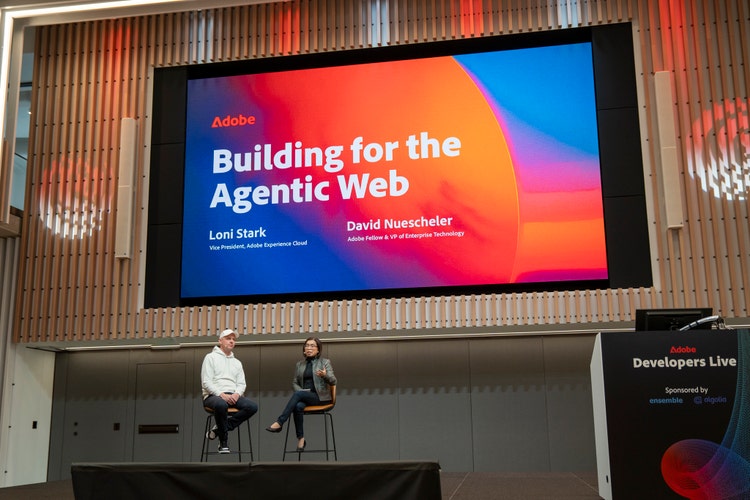
This perspective was discussed during the Building the Agentic Web keynote at Adobe (watch it below), where leaders described how AI is changing both how experiences are built and how they are consumed. The architectural changes in AEM follow directly from that shift.
https://youtu.be/wIJKwPBbuPk?si=eRujWhQ_nuKm24Oj
How AEM supports both humans and agents
When teams ask how AEM supports AI agents, they often expect a single feature or toggle.
In practice, it shows up across content modeling, delivery, and governance.
Structured content as durable knowledge
Content can no longer exist only for presentation.
Long-tail material such as FAQs, policies, specifications, and detailed documentation often plays a larger role than polished landing pages. These materials may be ignored by most human readers, but they are heavily consumed by AI systems that summarize and reuse information elsewhere.
For developers, this leads to a few practical priorities that tend to surface quickly:
- Content fragments function as reusable knowledge units
- Semantic structure carries more weight than layout
- Critical content needs to remain accessible without relying on client-side execution
The goal here isn’t volume. It’s clarity and consistency wherever content might be read or reused.
API-first access and delivery
AEM exposes core capabilities through APIs so content can be consumed consistently by browsers, services, and AI systems.
Edge Delivery Services play an important role here. They ensure content is delivered quickly while remaining readable to machines without requiring JavaScript execution or browser context.
In this environment, delivery architecture affects more than performance metrics. It directly influences whether AI systems can read and trust the content at all.
Trust, provenance, and governance
As AI systems consume and remix content at scale, trust becomes a system-level concern rather than a policy checkbox.
Adobe Experience Manager aligns with content authenticity initiatives to help establish provenance signals that indicate where content originated and how it should be treated. For enterprise teams, this becomes foundational to brand governance as content moves through AI-mediated channels.
Designing for humans and machines at the same time
One of the clearest implications of the agentic web is the need to design for two audiences at once.
Humans want experiences that feel intuitive, branded, and engaging.
AI systems want structure, accuracy, and completeness.
David Nuescheler, Adobe Fellow and Vice President, captured this tension during his talk. Humans are unlikely to read a 2,000-line FAQ. AI systems will read every line of it and summarize that information for others.
Traffic patterns reinforce this shift. The long tail now carries more weight than it once did, and that long tail is exactly what AI systems consume most aggressively.
For developers, this has direct architectural consequences:
- Long-tail content needs to be accessible and indexable
- Content fragments should be treated as durable assets
- Experiences need to support both extraction and interaction
AEM’s content modeling and delivery layers increasingly sit at the center of how brands appear in AI-driven conversations.
AI agents inside Adobe Experience Manager
Adobe Experience Manager now includes purpose-built agents designed to operate within defined system boundaries.
These agents are trained on AEM-specific behaviors and constrained by permissions, versioning, and review workflows. The intent is assistance, not hands-off automation.
The AEM agent model
Agents in AEM are designed to:
- Perform well-scoped tasks
- Operate transparently
- Integrate with existing workflows
- Keep humans in control of final decisions
The initial set includes agents for experience production, governance, advisory support, content optimization, and development workflows. Adobe’s approach aligns with emerging standards such as Model Context Protocol, allowing agents to work across tools without locking teams into a single interface.
How developer workflows change
The most immediate impact tends to show up in how developers diagnose and resolve issues.
During a live demonstration, Shankari Panchapakesan, Principal Product Manager at Adobe, showed how the AEM Development Agent analyzes pipeline failures by parsing logs, identifying root causes, and proposing fixes directly in context.
This does not remove developer judgment. It removes repetitive overhead.
Instead of manually downloading logs, tracing error paths, and reproducing failures locally, developers get:
- Line-level explanations
- Suggested remediation steps
- Clear before-and-after comparisons
AEM remains the system of record. The agent accelerates understanding rather than replacing decision-making.
Conversational experiences built on AEM content
Brand Concierge introduces a conversational delivery surface for content managed in Adobe Experience Manager.
Rather than navigating pages, users interact through conversation. Under the hood, AEM remains the authoritative knowledge source.
Cecily Liu, Principal Product Manager for GenAI and Brand Concierge at Adobe, demonstrated how conversational flows reuse existing AEM content while applying brand tone, governance rules, and citations.
For developers, this introduces a few new considerations:
- Conversational interfaces become another delivery channel
- Content models need to support reuse beyond pages
- Iteration and tuning matter more than launch completeness
This approach extends existing websites rather than replacing them.
Delivery and performance in an agentic context
Performance now affects both human experience and machine trust.
Sites Optimizer
Sites Optimizer identifies performance, accessibility, and quality issues and maps fixes directly into developer workflows.
Deck Reyes, Principal Customer Success Advocate at Adobe, demonstrated how recommendations surface as actionable tasks tied to source repositories rather than abstract reports. Optimization work can be prioritized and deployed using existing processes.
LLM Optimizer
LLM Optimizer focuses on AI visibility.
If AI systems cannot read or interpret your content, your brand is excluded from AI-driven discovery regardless of traditional SEO performance.
LLM Optimizer shows how AI systems perceive AEM-delivered content, highlights gaps between human and machine interpretation, and allows fixes to be deployed directly at the delivery layer. This closes a feedback loop that previously did not exist in most CMS architectures.
What developers can try today
For teams already working with AEM, there are practical steps worth taking:
- Review whether critical long-tail content is accessible without client-only rendering
- Evaluate content fragment models for reuse across pages, APIs, and conversational surfaces
- Use Sites Optimizer to surface delivery issues that affect visibility
- Test LLM Optimizer to understand how AI systems interpret your content
- Experiment with agent-assisted workflows in non-production environments
The focus is reliability, clarity, and control as content moves through more systems than ever before.
Key takeaways
- Adobe Experience Manager supports AI agents as direct consumers of content
- AEM architecture emphasizes structured content, APIs, and flexible delivery
- Agents accelerate workflows while keeping humans in control
- Performance and AI visibility are tightly connected
- Developers who adapt early influence how brands appear in AI-driven ecosystems
Frequently Asked Questions
Do AI agents replace traditional Adobe Experience Manager websites?
No. Human-facing experiences remain essential. AI agents introduce an additional audience rather than replacing websites built for people.
Do you need to re-platform Adobe Experience Manager to use AI agents?
No. AEM agents work across Managed Services, Cloud Service, and Edge Delivery Services without requiring a re-platforming effort.
How does this affect headless Adobe Experience Manager implementations?
Headless AEM implementations benefit when content models are designed for reuse and agent consumption. Structured content makes it easier for AI systems to read, summarize, and surface information across channels.
Can developers control what AI agents do inside Adobe Experience Manager?
Yes. All agent actions are transparent, reviewable, and governed. Developers and teams remain in control of final decisions and workflows.
Where to start
If you’re working with Adobe Experience Manager today, start by looking at how your content is being consumed outside of traditional pages.
Review whether critical long-tail content is accessible without client-only rendering. Check whether your content models support reuse across APIs, search, and conversational interfaces. Then experiment with agent-assisted workflows in a lower environment to see where they reduce friction without removing control.
The goal isn’t to overhaul everything at once. It’s to understand how your content behaves in an agent-driven world and make small, intentional adjustments from there.
That’s one direction. One mindset. One close.
Building with AEM?
Stay up to date on new features, developer tooling, and community events.