The Architectural Foundations of an Agentic Commerce Platform
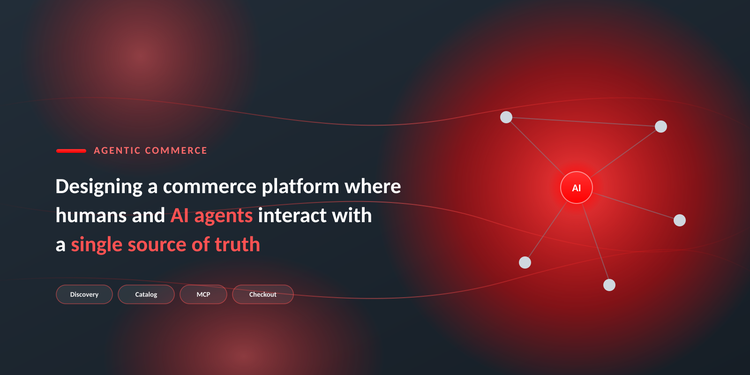
Commerce is undergoing a structural shift. Customers are no longer relying solely on search engines or browsing storefronts to explore their options. Instead, they’re turning to LLM-powered interfaces, chat-based assistants, and agentic shopping tools to ask questions, compare products across retailers, and accelerate early-stage decision-making.
These interfaces are powerful engines for discovery, education, and comparison. They help customers clarify needs, evaluate trade-offs, and narrow choices faster than traditional browsing.
Yet when it comes time to complete a purchase, customers still overwhelmingly prefer trusted storefronts and brand-owned sites where payment security, fulfillment transparency, and post-purchase service are well understood. Conversion remains anchored in environments where trust has already been established.
Importantly, AI does not disappear at this stage. When customers arrive on a brand’s owned storefront, agentic AI can enhance the experience by guiding product selection, personalizing recommendations in real time, answering objections, bundling complementary items, and streamlining checkout. In these trusted environments, AI becomes a conversion accelerator, improving completion rates, and increasing average order value.
To compete in this new landscape, enterprises need a commerce foundation that is structured, governed, and optimized for both human and agent consumption. Adobe Commerce is built for this shift, and the principles below outline what it takes to be truly agent‑ready.
A commerce architecture built for two audiences
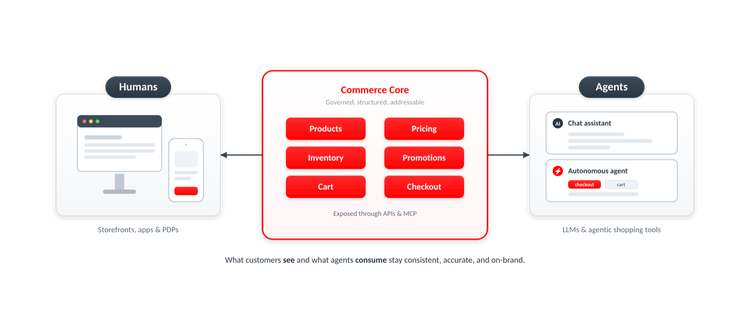
Agents perform best when working with clean, structured data delivered through predictable APIs rather than attempting to interpret JavaScript or infer business rules from presentation layers. That means product specifications, pricing, availability, and promotional logic must exist as addressable resources exposed through APIs and standardized interfaces such as MCP servers. When both human- and agent-facing surfaces draw from the same underlying source of truth, brands ensure that what customers see and what agents consume remain consistent, accurate, and on-brand.
This dual-surface architecture is the foundation of agentic commerce.
A catalog designed for machine reasoning
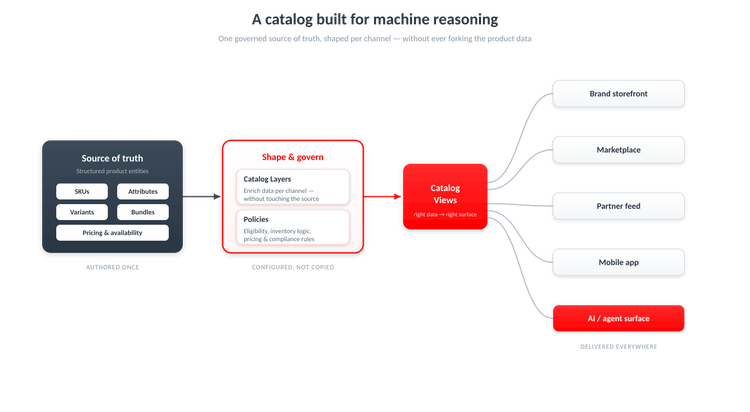
The catalog is the core of agentic commerce. It must be structured for machines, governed for compliance, and flexible enough to support the full range of human and agent interactions. Adobe Commerce’s catalog model built around catalog views, policies, layers, and structured product entities is designed for this future.
Catalog views define where and how product data is exposed, whether to a storefront, marketplace, partner feed, or AI surface. Each view can carry its own product availability, pricing, and attribute visibility rules, ensuring that the right information reaches the right consumer or agent. Catalog layers enable you to enrich product data for specific channels without modifying the source product data. Policies govern customer eligibility, inventory logic, pricing, and compliance constraints. Combined, enterprises have precise control over what catalog data an agent can access or act upon.
MCPs as the common language for agents
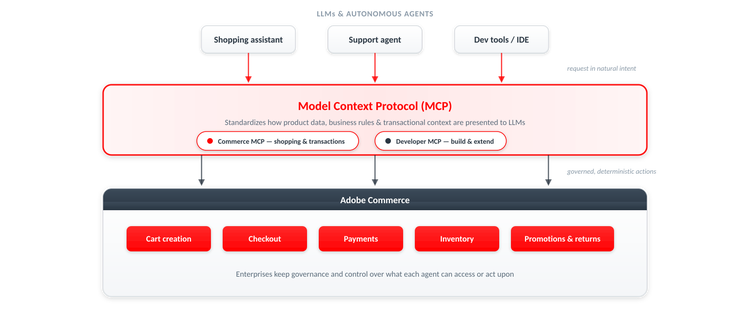
For Agentic Commerce to function end-to-end, ecommerce platforms must support standardized protocols that allow agents to securely execute actions such as cart creation, checkout initiation, payment orchestration, inventory validation, promotions, and returns.
Through native support for Model Context Protocol (MCP), Adobe structures and exposes commerce capabilities in a way that LLMs can interpret consistently. MCP standardizes how product data, business rules, and transactional context are presented to LLMs, ensuring agents can reason over them reliably while enterprises maintain governance and control. With the Commerce MCP, businesses can build custom agentic experiences like shopping assistants, agentic cart creation, support agents, and much more.
The Developer MCP brings AI-powered development capabilities that enable teams to rapidly extend platform functionality and deploy composable storefront components. By embedding Adobe's knowledge sources, documentation, and platform best practices directly into the development workflow, the Developer MCP helps new developers onboard faster and become productive from their first sprint. It generates code that follows proven architectural patterns, is easy to maintain, and meets the quality standards that enterprise commerce demands. The result is a significantly compressed path from idea to production, giving enterprises the speed to experiment, iterate, and ship commerce capabilities ahead of competitors.
Adobe is also committed to supporting agentic commerce protocols such as Agentic Commerce Protocol (ACP) and Universal Commerce Protocol (UCP), enabling product discovery and secure, standards- based transactional interactions between agents and your storefront
By embracing open protocols rather than point integrations, Adobe ensures commerce interactions are governed, deterministic, and secure while enabling a new model of agent-to-merchant engagement where trusted agents can transact directly under clearly defined policies.
Telemetry and continuous optimization
In an AI-mediated ecosystem, telemetry becomes the strategic advantage. Businesses need visibility into how their brand is represented across LLMs, how accurately agents represent their content, how agent-referred traffic converts, and where governance or compliance issues arise. They also need operational telemetry that tracks agent execution and anomaly detection across agent interactions.
Adobe gives you visibility into how your products appear in LLMs, enhances product data with AI, and increases readability of your data by LLMS. By adding meaningful context to your catalog, it helps LLMs not only discover your products accurately, but understand what they are, who they’re for, and why they matter to customers.
Additionally, your product detail pages that have been optimized for human consumption can often have data that is invisible to agents. This data could be hidden behind modals, configurators, and linked pages. Agents may not fully understand product categories, bundles, and variants. Adobe can identify this critical missing information and deploy it as JSON-LD to the edge so agents can get all the relevant product data.
Through this constant telemetry and optimization brands can ensure maximum visibility and stay competitive across LLMs.
Why this matters
Ecommerce is no longer confined to storefronts and search results. Discovery, evaluation, and transactions are increasingly mediated by LLMs and autonomous agents. This shift changes the mechanics of visibility, the dynamics of control, and the foundations of trust. The brands that win will architect for an AI-native foundation.