Is Your Adobe Express Add-on Ready for Large Document Support?

Large Document Support is an important capability for enterprise customers who want to work on bigger and more ambitious projects.
Adobe Express will therefore roll out support for larger, more sophisticated documents over the coming months. As this evolves, developers will soon see new APIs and patterns that reflect how Adobe Express will handle these richer document experiences going forward.
This is an exciting opportunity for add-on developers to prepare now, so your add-ons can participate in these more advanced creative workflows as the platform evolves.
What this means for add-on developers
While Large Document Support in Adobe Express will begin rolling out in the next few months, we’re intentionally taking a phased approach to minimize disruption. The detailed migration guidance can be found in the documentation.
Existing marketplace add-ons are not expected to break overnight. Instead, developers whose add-ons are impacted will have a transition period (up to six months) to understand the changes, update their implementations, and republish before enforcement begins.
Here’s the simplest way to think about what to do next:
- Assess your add-on. Review the documentation and determine whether your add-on uses patterns that may be affected by Large Document Support. The Large Document Support Checker Skill, described below, is the fastest way to get a first read.
- If your add-on is impacted, plan your transition. Review the migration guidance, understand the rollout phases, and use the migration window to update and resubmit your marketplace version.
- If your add-on is not impacted, no action is needed today. Stay informed as additional guidance becomes available.
Assess faster with the Large Document Support Checker Skill
To help you with that first step, Adobe provides the Large Document Support add-on check skill, a lightweight tool you run with your LLM of choice.
It scans your add-on’s own source directly, no build step and no bundling required. Point it at your source folder, and it flags the exact unsafe patterns this rollout is built around — the deprecated APIs and the node-reference shapes that break under the new model.
For each finding, it explains why that shape breaks and shows a before/after fix. It can apply the fixes on request, re-check your code afterward, and doubles as a CI or pre-commit gate so regressions don’t creep back in.
To try it, just ask your agent to “check my add-on for Large Document Support safety using the provided skill” and point it at your add-on folder.
Treat its result as a starting point for your assessment, not a verdict. It can produce false positives and false negatives, so always validate against the testing environment, regardless of what it reports.
Where existing add-ons may run into trouble
These are the types of workflows that are most likely to be affected:
- Performing actions across multiple pages
- Traversing content throughout a document
- Modifying document content outside the active page
- Relying on assumptions that the entire document is always available
If your add-on falls into one of these categories, we recommend following the guidance closely.
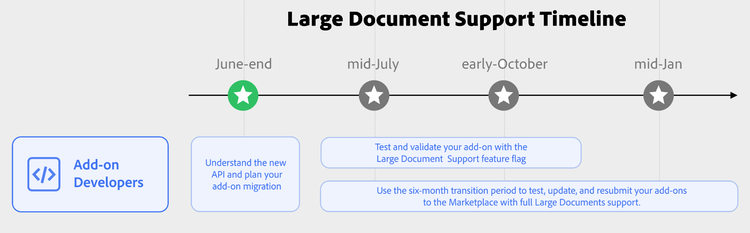
The milestone dates are planning targets and may shift as the rollout proceeds. Treat the sequence and the actions as stable; confirm exact dates against the latest announcements before planning around a specific deadline.
Stay informed
The goal of Large Document Support is to help Adobe Express scale reliably as projects become more sophisticated. That means the way some content is loaded and accessed may change, and add-ons that assume everything is always available may need to evolve with it.
For now, the most important thing is awareness. If your add-on depends on document traversal, inactive-page access, or other document-wide behaviors, visit the documentation, run the Checker Skill against your source, and follow future updates closely. If it doesn’t, there’s nothing you need to do.
We will continue to share updates as more details become available. In the meantime, please treat this as an early heads-up rather than a migration notice.